
"Quick" look at the new OV-pas
Analysing the successor of the OV-Chipkaart from a technical perspective.

The new OV-pas has been launched last november (2025), I got an email, as a pioneer, saying I could order one:
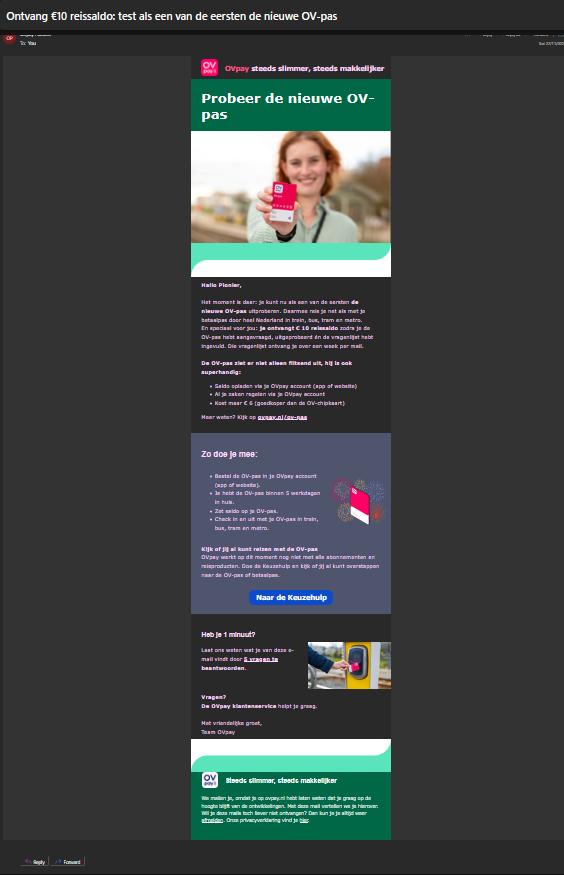
So, obviously, I ordered one (for 6 euro. That's 1,50 euro or 50 cents (depending where you get it) cheaper than the predecessor.)
A few pictures of the OV-pas:
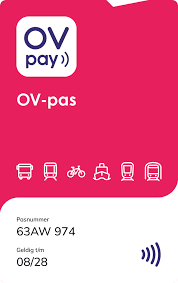
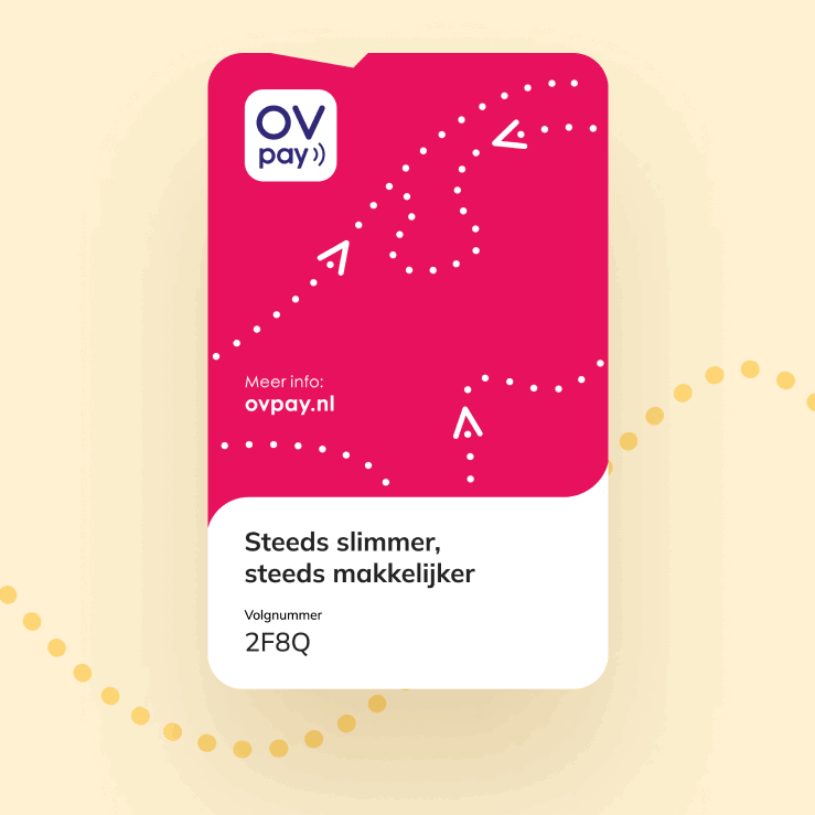
The backside where
[1] "Steeds slimmer,"
[2] "steeds makkelijker"
is written is changeable while ordering. If you choose nothing, that placeholder will be used.
The requirements are:
- maximum of 22 characters per line
- letters
- spaces
- commas
- dashes
- periods
NOTHING else, no numbers, no @s.
My personal opinion is that this arbitrary limitation is stupid. For example, if you lost your card, no one can call/message you (because there can't be any numbers), and no one can email you (because @ is not allowed), though this can be worked around.
When you buy the card in a store (like in Primera or at a service counter at a central station) a barcode will be placed. This barcode is able to be scanned so you can load it with money at the store or a service counter.
The card has a lifetime of 5 years, before you need a replacement.
The hardware
The OV-Pas is a JavaCard. It's made, or at least designed, by Infenion (apparent by the UID and CPLC).
I'm not sure, but the most likely thing what happens after is that Thales DIS (formerly Gemalto) presses the card in shape, loads the software on it, and programs it. After that, the card is printed on and is shipped. I have asked TLS (TransLink systems, the manager of the whole transit payment system) on 04/06/2026 for comment, but have not received a reaction as per 12/09/2026.
The software
The OV-Pas is a white-label EMV card, this means that it does not have any connection to a payment network like Visa or Mastercard. Instead, it uses its own network, simply called "OV-Pas".
The AID of the EMV applet is A0000007800007.
The card runs Thales DIS' Javacard OS, called Gemalto TOP. It is compliant with Javacard version 2.3. It also runs Global Platform version 2.3.
The BIN of the card is 22371700. This BIN is not assigned by MasterCard, the owner of the range it is in.
The card is probably connected to MasterCard as the BIN is theirs, it has the MasterCard card manager, and back when they were planning on connecting a real debit account to the card it was with bunq and MasterCard.
If you want to see more things about the card that I don't understand and thus have not included here, here you go:
Proxmark scan: https://gist.github.com/AliBello/47797bb6f8bbe3e9c2794e2843636c99
NXP TagInfo scan: https://gist.github.com/AliBello/193552a656c79423a46d82fd7c72983a
I have removed the UID and PAN for some anonymity, but it was probably a futile effort as there are likely other ways to identify me.